
Documentation
Confocal microscopy
Learn all about confocal microscopy and what it can do

What is confocal microscopy?
The confocal microscope scans a laser beam through a sample to excite molecules that are in focus. The molecules then emit photons, which are measured by a detector. A pinhole in front of the detector blocks out-of-focus light and hence improves image quality.
Confocal microscopy offers an improved resolution and signal-to-noise ratio over widefield. The ability to vary the height of the focal plane simultaneously while experimenting is also remarkably useful for 3D reconstruction of larger specimens. This method is more time-consuming than widefield in acquisition and image production and generally higher maintenance, in some cases there is also a tradeoff where some resolution is sacrificed to distinguish different structures in a given sample. Confocal Microscopy is an excellent method of optical imaging often preferred by researchers for applications involving visualization of genetic material or structural components of cells. It enables the assessment of the colocalization of structures and has had large ramifications in studies of the viability of cells.
Confocal microscopy offers an improved resolution and signal-to-noise ratio over widefield. The ability to vary the height of the focal plane simultaneously while experimenting is also remarkably useful for 3D reconstruction of larger specimens. This method is more time-consuming than widefield in acquisition and image production and generally higher maintenance, in some cases there is also a tradeoff where some resolution is sacrificed to distinguish different structures in a given sample. Confocal Microscopy is an excellent method of optical imaging often preferred by researchers for applications involving visualization of genetic material or structural components of cells. It enables the assessment of the colocalization of structures and has had large ramifications in studies of the viability of cells.

Figure 1: Three color confocal image of Cas9 binding to a single DNA molecule tethered between two optically trapped beads. Blue/green/red markers indicate the position of individual Cas9 complexes.
Solutions
C-Trap
Molecular biology as never seen before
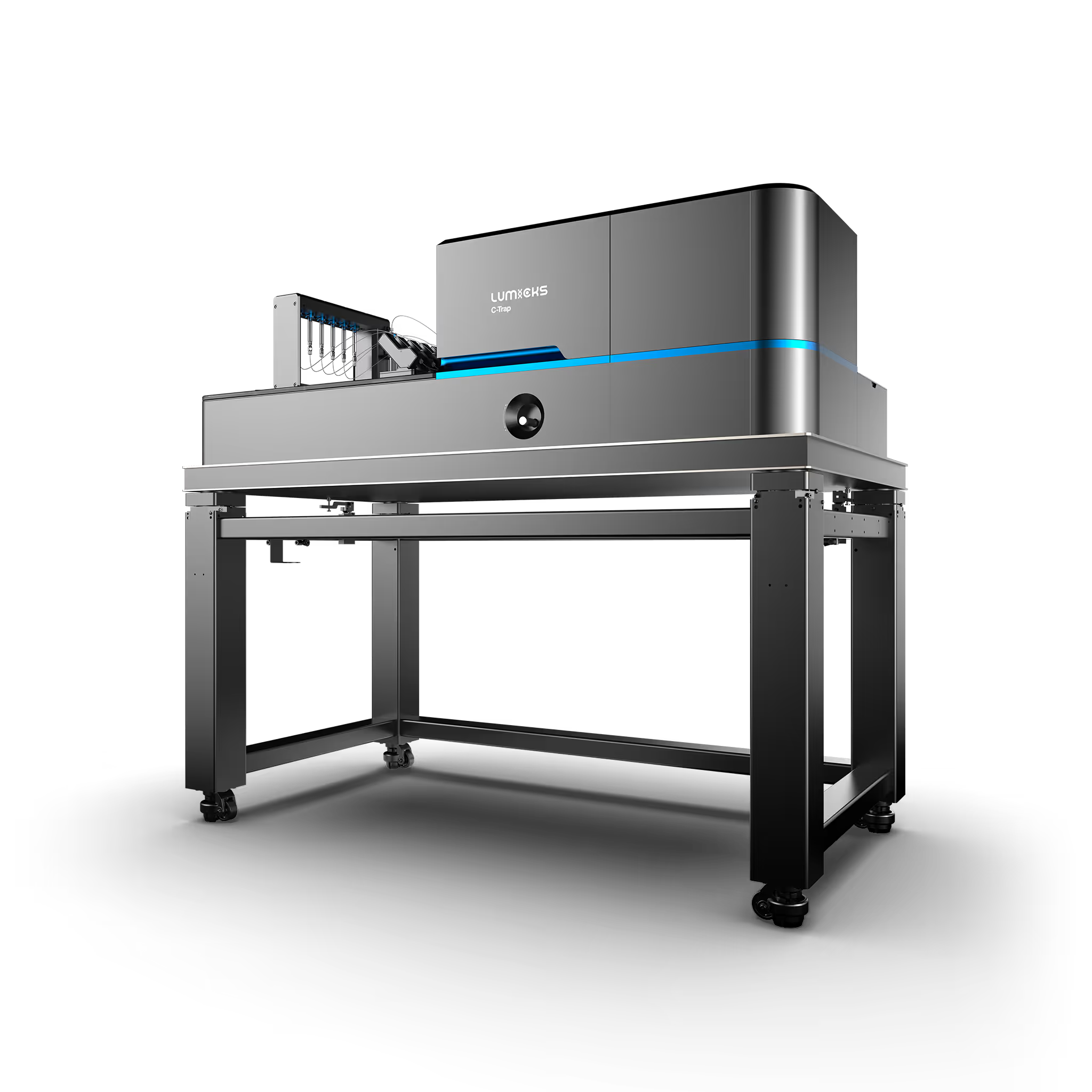
The C-Trap® provides the world’s first dynamic single-molecule microscope to allow simultaneous manipulation and visualization of single-molecule interactions in real time.
Technical note:
Filter CA and show 4 Latest
This shows the most recent card of each resource type filtered on Business Unit CA.
Webinar, Scientific update, Whitepaper, Application note, Brochure.
We only show 4 and we have 6 types so the 2 older ones are hidden.
In design only 1 is shown, but the rest will be loaded when published.
Filter CA and show 4 Latest
This shows the most recent card of each resource type filtered on Business Unit CA.
Webinar, Scientific update, Whitepaper, Application note, Brochure.
We only show 4 and we have 6 types so the 2 older ones are hidden.
In design only 1 is shown, but the rest will be loaded when published.
Button Text

Revolutionize binding for the future of immunotherapy: A virtual Avidion demo
Webinar
April 15, 2026
01-01-20
90% of immuno-oncology drugs entering Phase I clinical trials fail, due to a poor predictive value of current preclinical assays. To solve this, scientists and drug developers are turning to Cell Avidity, the total binding strength between cells, to better predict therapeutic efficacy.
Join us for an exclusive virtual demonstration of Avidion, the next generation of Cell Avidity technology. This session isdesigned for researchers and groups who understand the "why" of avidity but want to see the "how."
We will take you inside the instrument to explore the automated workflow, preview our intuitive software interface, and show real-world customer proof that validates its predictive power. See how Avidion transforms complexcellular interactions into actionable insights with push-button simplicity.
We know your time is valuable, that's why we designed this 30-minute intensive session specifically for researchers who need to seethe technology in action. Don’t miss your chance to talk directly with LUMICKS scientists and product managers. See the future of cell interaction analysis from your desk.
This is some text inside of a div block.

Text Link

Enhancing efficacy against clear cell renal cell carcinoma through format-tuning of bispecific T cell engagers
Scientific update
January 29, 2025
01-01-20
This is some text inside of a div block.

Cell Avidity: a key to accelerate IND filing in cell therapy drug development
Whitepaper
July 1, 2023
01-01-20
This is some text inside of a div block.

Accelerate your cell engager discovery with high throughput measurements of Cell Avidity
Application note
June 1, 2023
01-01-20
T cells play a pivotal role in tumor immunosurveillance. Multispecific cell engagers (CEs) have been adopted in the field of immuno-oncology to redirect T cells toward cancer cells, thereby unleashing the anti-tumor potential of the patient’s immune system. CE-mediated cell binding induces T cell activation and the formation of an immunological synapse, which is a prerequisite for effective tumor cell lysis.
The strength of the initial binding events between a T cell and a tumor cell dictates the efficiency of the anti-tumor response. Assessing cell avidity, i.e. the total intercellular interaction strength between two cells, gives crucial insights into the efficacy of CEs as anti-tumor therapeutic agents.
Here, we deploy LUMICKS’ high throughput avidity measurement (HTAM) technology to measure CE-induced cell avidity in a high throughput manner. We demonstrate the assay performance characteristics, i.e. specificity, precision, and range, via CE titration experiments in the context of a Jurkat T cell model system. We find that the HTAM CA assay is suitable for candidate screening in high throughput, with high sensitivity and precision.
This is some text inside of a div block.


Cell Therapy Case Study Collection
Brochure
September 8, 2025
01-01-20
This is some text inside of a div block.
Let’s get in touch
Our team is standing by to help you